



Have you ever found yourself trapped in a cycle of intrusive thoughts that refuse to fade? Often, we fight with these thoughts in our minds by thinking positively or ignoring them entirely, but deep inside, they are shouting louder!
In the world of psychology, there is a procedure that helps with these thoughts, known as “Socratic questioning.” It is named after the Greek philosopher Socrates.
It’s a discipline method that uses guided questions to help people challenge unhelpful thoughts and develop healthier thinking patterns. Rather than arguing with oneself, it helps to understand the mind in a better way.
Mental health experts use this approach with CBT to help people toward lasting, meaningful change.
What is Socratic Questioning?
The Socratic questioning is a form of “Guided Discovery.” It can be used to identify assumptions and explore beliefs that were previously preconscious.
It is defined as using questions to ‘clarify meaning, elicit emotion and consequences, as well as to gradually create insight or explore alternative action.’”
— James, Morse, & Howarth (2010) as cited on PositivePsychology.com
The Socratic method can be used to pursue thoughts in different directions and for different purposes. This includes exploring difficult ideas, getting to the truth of things, opening up about problems, distinguishing what we know from what we do not know, or following out the logical consequences of thoughts.
This concept is based on the idea that thinking has structured logic and allows underlying thoughts to be questioned. However, the goal isn’t to win an argument against yourself, but to understand the internal feelings, as it helps people to move from emotional reactivity to logical thinking.
Why Socratic Questioning Matters?
All the thoughts in our minds are not always accurate, which severely impacts our emotions, relationships, and decision-making. However, this method helps in slowing down the thoughts and gives them direction. It helps in building a strong connection with the mind and distinguishes between facts and interpretations.
After some time, the Socratic method makes the mind intellectual, where a person can recognize that their “thoughts can be wrong”. Moreover, accepting these changes helps in moving on and learning new perspectives in life.
Socratic Questioning in CBT
Socratic questioning in CBT is a technique where a mental health expert asks questions to help individuals examine their thoughts and beliefs and develop more balanced thoughts. Instead of arguing with the patient’s belief, a therapist guides them to discover their thoughts themselves. This method helps in thinking deeply about irrational thoughts.
By using this method, people can develop a deeper understanding of their thought patterns and behaviors, which leads to positive change. It improves emotional and behavioral well-being and develops more effective coping strategies for managing stress, anxiety, and other mental health issues.
Six Core Types of Socratic Questions
There are different question styles used in this method, which makes people think in bigger ways. These questions create a flexible framework and are essential to solving problems, which one can adapt in conversations or self-reflection.
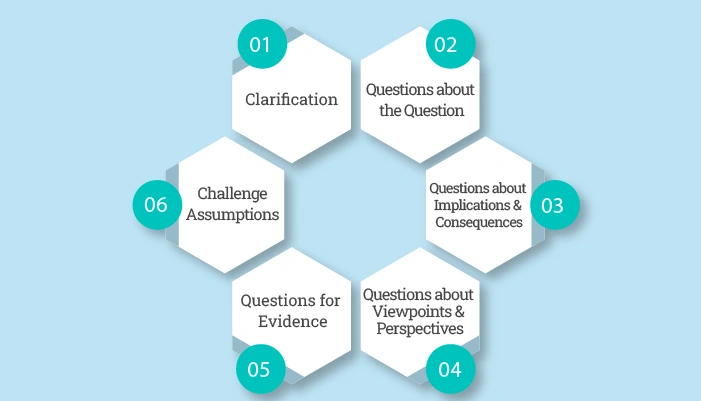
In fact, the Socratic method of questioning is the essence of critical thinking. So, here are the six core types, ehoch includes:
1. Clarification
Clarification ensures everyone understands the language and basic concepts, so they know exactly what is being discussed.
Example:
- What exactly do you mean by ‘failure’ in this situation?
- Can you give me a specific example of what happened?
2. Challenge Assumptions
Assumptions are beliefs and habits, in which people think negatively, such as thinking about the problem, or by exploring alternative views. Sometimes they prove their initial assumptions to be true or disprove them.
Here are some of the common examples:
- “What are we taking for granted here?
- “How did you arrive at that conclusion?
3. Questions for Evidence
These questions examine how you know what you think you know. Individuals focus on the foundation of an argument, asking for facts or logic to support a claim in conversations.
Example:
- How do you know that?
- What evidence do you have that this thought is correct?
4. Questions about Viewpoints & Perspectives
These questions broaden the thinking and help one to step outside their current thoughts and consider alternate options.
Example:
- What is another way to look at this?
- How does someone who disagrees with your thoughts respond?
5. Questions about Implications & Consequences
These questions help in exploring where a particular thought leads and what the results would be if it were true.
Example
- If this is true, what does it mean for our future?
- What are the consequences of this?
6. Questions about the Question
This is a metacognitive step where one may analyze the purpose of the question itself.
It’s like thinking in a deep way, about what the other person thinks, and the point of their questions.
Example:
- Why do you think I asked that question?
- What was the point of asking that?
How does Socratic Questioning Help with CBT?
Socratic questioning in CBT is a collaborative technique where a mental health expert asks open-ended questions to help clients identify, challenge, and restructure irrational thoughts. It promotes self-reflection and empowers people to examine evidence. This method helps patients to take charge of their healing journey. It can be used in multiple sources, as it’s a demanding technique.
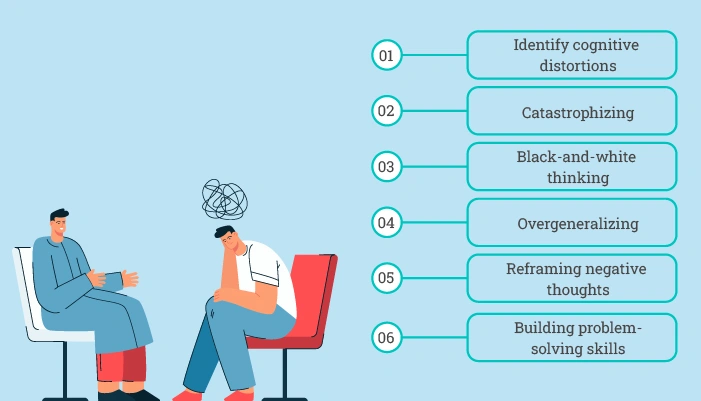
Here is how this collaborative approach works:
- Identify Cognitive Distortions: It involves recognizing irrational or overly negative patterns of thinking.
- Catastrophizing: In this method, a therapist evaluates the likelihood and impact of an individual’s fears. And ask questions, such as, What’s the worst that could happen?
- Black-and-White Thinking: A mental expert challenges the beliefs by asking individuals to consider the shades of gray and explore alternative possibilities.
- Overgeneralizing: It helps individuals to find evidence by denying their statements while acknowledging alternative options. By learning to see situations from different angles, people can reduce stress and improve their emotional responses.
- Reframing Negative Thoughts: It involves changing the way negative situations or events are interpreted, which allows a more positive perspective. This technique helps transform negative thoughts into balanced viewpoints and improves emotional responses.
- Building Problem-Solving Skills: CBT helps in different ways, such as by equipping individuals with effective problem-solving skills to address irrational thoughts in a constructive manner. Moreover, by doing this, individuals can gradually overcome avoidance behaviors and build confidence.
Examples of Socratic Questioning During CBT
During CBT, this method involves asking specific questions to help patients challenge their thoughts and beliefs. These questions encourage deep critical thinking and help patients change their assumptions.
Examples include:
- Is there any evidence for this belief?
- Is this thought based on facts, or is it an assumption?
- What will happen in the worst-case scenario, and how likely is it to happen?
- Why have you overreacted to this situation?
- Is there a real-life example that reinforces what you are saying?
- What do you expect to happen once you resolve the conflict?
- How is that working for you?
Socratic Questioning Across Various Mental Health Conditions
This method is effective across various mental health disorders. Here are some of the mental health issues:
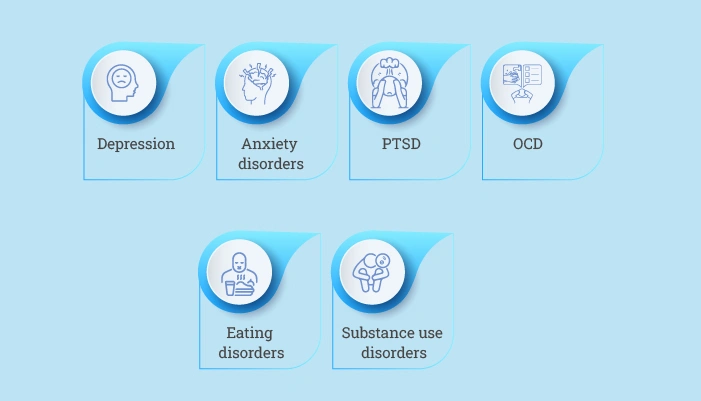
- Depression: It challenges negative viewpoints about oneself, the world, and the future.
- Anxiety disorders: It can help in examining catastrophic predictions and overestimations of threat.
- PTSD: It involves questioning unhelpful beliefs about safety, trust, and responsibility.
- OCD: This method challenges the overimportance given to intrusive thoughts.
- Eating disorders: Examining distorted body image and perfectionism.
- Substance use disorders: it helps by questioning beliefs that lead to addictive behaviors.
For example, someone struggling with social anxiety might think, “Everyone at the gathering will judge me negatively.” Through Socratic questioning, they might get a new perspective, such as “How do you know what others will think? What’s the worst that could happen, and could you cope with it?”
How Socratic Questioning Helps in Daily Life?
Beyond therapy, it enhances different aspects of life, which include:
1. Personal development
It helps in examining different beliefs about the capabilities to gain a deeper understanding of thoughts. It enhances self-awareness and intellectual humility.
2 . Professional growth
It helps in challenging and approaching new information with curiosity, which enhances career progress and helps in learning new things. Such as asking questions like “why” and “how” rather than just accepting facts.
3. Relationships & Communication
It helps individuals understand others’ viewpoints rather than arguing, which enhances empathy and improves communication, and one can form better relationships.
4. Decision-making
Instead of making decisions impulsively, this method analyzes assumptions and evidence to reach better, more informed decisions.
5. Enhanced Emotional Regulation & Mental Health
It helps in identifying and challenging cognitive distortions (for example, “What is the evidence for this thought?, why am I thinking this way?). This helps in lowering anxiety and reducing stress.
6. Problem-solving
Breaking down difficult problems through systematic questioning in the mind to gain a deeper understanding of the issues at hand, which eventually helps in solving problems easily.
Moreover, all these everyday questioning strategies help people develop critical thinking skills that improve their quality of life.
Nurture Your Well-being at Renewed Mental Health Group
If you are looking for a place where you can get mental health treatments, with the Socratic method, look no further! The Renewed Mental Health Group is here to help.
We have a team of mental health experts who create a safe, non-judgmental environment so that you can talk about your issues without the fear of judgment. Our certified experts offer compassionate, evidence-based methods like CBT and Socratic questioning to support meaningful, lasting change.
Contact us today for a confidential consultation and take the first step toward a healthier future.
Your journey to wellness starts here!
In a Nutshell
Socratic questioning is a form of questioning that can be used to pursue thought in different directions and for different purposes. It is based on the foundation that thinking has structured logic. It can be helpful with the CBT technique as it fosters critical thinking, emotional growth, and long-term change. It helps individuals to examine their thoughts, challenge distorted beliefs, and explore alternative perspectives. This method supports greater self-awareness and resilience. Whether addressing anxiety, depression, or unhelpful behavior patterns, Socratic questioning empowers individuals to create lasting shifts in how they think, feel, and act.