



When we talk about dissociative disorder, we are talking about the condition where a person’s complete sense of self, like memory, feelings, and identity seriously mixed up without their realization of it.
These problems, like being completely separated from yourself or losing big chunks of memory, are not signs of weakness. Instead, your brain is trying to protect you from the extreme stress or terrible events of the past.
When you find yourself lost in your surroundings and find yourself in another world for some time, this is the condition called dissociation.
But the good news is that, even with this chronic condition, it is treatable with the help of mental health specialists.
Dissociative Disorders, as The Brain’s Survival Trick
At its core, dissociation acts like a natural protective shield for your mind. When someone goes through traumatic events, especially chronic, intense abuse, or was neglected as a child, the brain creates emotional space to protect itself from pain that is too much to tolerate.
This space makes the brain feel it is unreal or like it is happening to someone else.
It is common for people to continue dealing with stress from their childhood long after the trauma is gone. Because the brain is still in a developing phase, when a bad thing happens, it never learns other better ways to handle tough feelings. This means that as an adult, a person keeps feeling dissociation and disconnected from reality.
How Dissociation Works in the Brain?
This way of protecting yourself is connected to how your brain is built. When you feel disconnected (dissociate), there is a way the brain’s parts work differently.
1. The Prefrontal Cortex (PFC)
This part is right behind your forehead, which normally helps you manage feelings and feel present. When you dissociate, this area slows down. That is why you feel emotionally numb or like your mind simply has shut down.
2. Amygdala
The amygdala is the brain’s fear center. It can become too active during a flashback of past traumas and make you feel terrified. But when you feel detached, the amygdala can be underactive. This dulls your feelings and makes you feel completely separated from everything.
When you know that these feelings come from specific changes in the brain, it confirms that this was simply your mind’s way of staying safe.
The Types of Dissociative Disorders
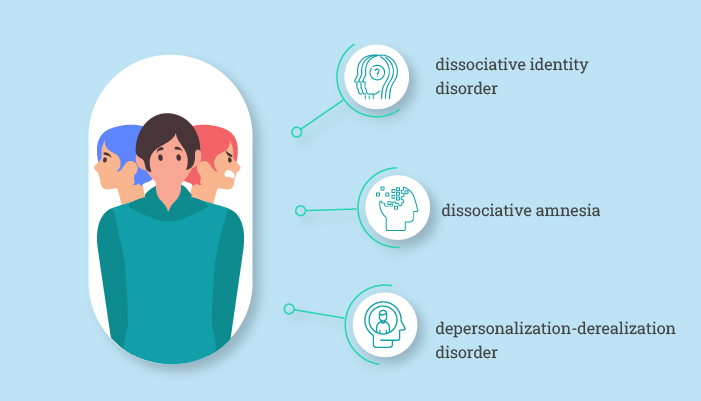
There are three main types of dissociative disorder,
- Dissociative identity disorder
- Dissociative amnesia (which includes fugue)
- Depersonalization-derealization disorder
There are also two categories, i.e., specified and unspecified dissociative disorders, which cover conditions that do not fully meet the criteria for the other types.
Major Symptoms of Dissociative Disorders & Conditions
There are different symptoms in three major types of dissociative disorders.
1- Dissociative Identity Disorder (DID)
Dissociative identity disorder symptoms, which is also called multiple personality disorder, involve having two or more different personalities.
This is the fragmentation of a single identity, and not the creation of multiple separate personalities. These personality changes may have different names, ages, genders, and even physical characteristics. Instead of a complete or cohesive identity, the individual experiences a lack of continuity and memory gaps, as if different parts of their life and sense of self belong to different people.
The different identity states or alters result from a failure to realize different aspects of self, memory, and awareness, which is often a response to severe trauma. The person may have trouble with daily functioning. Changing between identity states, or “switching,” can happen quickly and cause confusion and worry.
The most important thing for diagnosis is continuous and major amnesia, which means having ongoing gaps in memory about everyday things, important personal facts, or past traumatic events.
2- Dissociative Amnesia
This type of dissociative disorder is mainly an inability to remember important personal information about yourself that is traumatic, and is not a simple forgetfulness.
In simple words, Dissociative Amnesia is a serious kind of memory loss where you cannot remember important things about yourself and your life. It is not just like forgetting where you put your keys or missing a name. The forgotten information is usually tied to a very stressful or traumatic event, like abuse, war, or a terrible accident. It is a mental block, not a physical problem with your brain. Your mind blocks out the memories to protect you from the fear and pain of what happened.
- Localized amnesia, where a person cannot remember an entire event or period of time (this is the most common).
- Selective amnesia, where only specific details of an event are forgotten.
- Generalized amnesia which is a complete loss of identity and life history.
- Dissociative amnesia can last from minutes up to a few years, but it usually lasts less than a week.
2- i) Dissociative Fugue
This is the subtype of dissociative amnesia, where a person physically moves from their home, town, or city to another place where they assume their new identity or become confused about their own identity.
3- Depersonalization-Derealization Disorder
This is characterized by persistent, recurring feelings of being detached from oneself (depersonalization) or from one’s surroundings (derealization), while being aware that these feelings are not real.
Depersonalization involves feelings of being outside, watching your own actions, feelings, or thoughts from a distance, or feeling like a robot.
Derealization involves feeling that the world around you is unreal, fake, dream-like; your surroundings might look blurry or separated by a glass wall.
A key point is that the person knows that his feeling of unreality is actually not real.
How Psychiatrists Make a Diagnosis
The diagnosis is something tricky and relies on a long talk with a psychiatrist or a clinician, not just a test.
A common short test that psychiatrists use is called the Dissociative Experiences Scale (DES-II).
If a person scores above 30 on this test, it means they should see a special mental health professional for a closer look.
To make an official diagnosis, the specialist uses a careful, structured way of talking called the Structured Clinical Interview for Dissociative Disorders (SCID-D. This helps the doctor to make sure they follow all the rules for diagnosis correctly.
The mental health professionals also have to make sure that a person’s problems are not caused by taking drugs.
Effective Treatment for Dissociative Disorders
Treatment for dissociative identity disorder strongly focuses on long-term, specialized talk therapy because these conditions stem from complex, long-lasting trauma. This treatment typically follows steps based on established guidelines.
The most common model for treating dissociative personality disorder is set up in three stages. This is how people usually go through therapy to heal from very hard past experiences. It happens in three main steps.
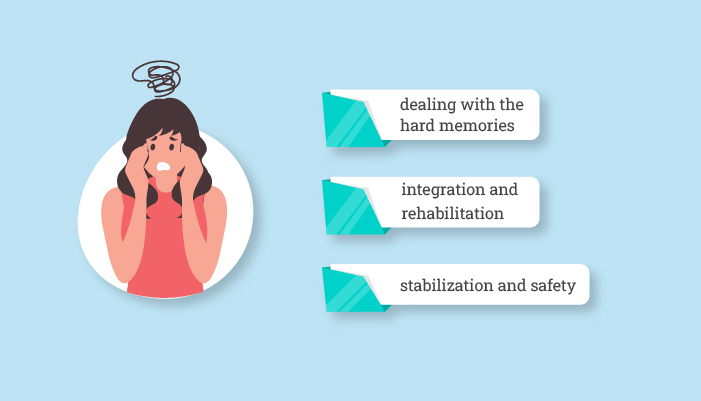
Phase 1: Stabilization and Safety
This phase is about getting things under control. It focuses on controlling emotions, stopping dangerous behaviors like self-harm, and reducing active symptoms. During this stage, the person learns important skills to help bring them back to the present moment. Only when the person is stable and has enough coping skills, then therapy moves to phase 2.
Phase 2: Dealing with the Hard Memories
Once you feel safe and stable, you start to work through the memories of the difficult past events. Your therapist makes you feel that past traumas in controlled and careful settings that you face them. The goal is to put those memories in their proper place so they no longer can control you.
Phase 3: Integration and Rehabilitation
The final stage is about getting your peaceful life back and having a strong, single sense of yourself. You work to fix any remaining inner conflicts and get better at relationships and life skills. This phase helps you move beyond the past and fully rejoin your life.
Different types of Therapies
1. Cognitive Behavioral Therapy (CBT)
Cognitive behavioral therapy for dissociative disorder has a clear goal and plan. Your therapist helps you look closely at your thoughts and feelings. The goal is to learn helpful ways to stop negative thinking or acting. You will learn to use healthier ways of thinking and better habits instead.
2. Dialectical Behavior Therapy (DBT)
DBT is a special kind of therapy for people whose feelings are very strong or intense. The main target is to find a balance between these feelings. Your therapist helps you learn new skills with different phases to manage your emotions better, so they do not feel so overwhelming.
How Can We Help You?
Dissociative disorders are serious problems that happen when the brain needs to find a way to survive very difficult traumatic situations that happened in the past.
The signs of these symptoms are complex and need a serious diagnosis from professionals who understand the mental complex issues and find treatments.
The most important step toward getting better is finding a specialist who understands these problems and knows how to use this step-by-step treatment approach.
The Renewed Mental Health Group can learn about your symptoms and make suggestions according to the treatment. We have specialized clinicians, psychiatrists, and psychologists who can solve all your mental health-related problems, whether complex or normal.
We can help you unlearn the past traumatic life and live your present peaceful and normal life like other people. Our treatment focuses on different steps to make you feel safe, helping you to pass the difficult events.
Is there anything else you would like to know about mental health issues, or would you prefer to book an appointment for dissociative disorder? We are here to help you.