



Do you ever hear things that others can’t, such as noises, whispers, or conversations? If yes, you might be experiencing psychotic disorders.
Psychotic disorders are also known as Psychosis. It’s an umbrella term for symptoms that involve a loss of contact with reality. Individuals with this disorder lose touch with reality and experience hallucinations and delusions.
Moreover, a clinical diagnosis is given when these symptoms are persistent and interfere with daily functioning. It usually occurs during the transition from childhood to adulthood, late teens to mid-20s. However, older adults with brain disorders may also be at higher risk for psychosis.
According to the recent research by the National Institute of Mental Health, approximately 1.5 to 3.5% people around the world struggle with psychosis. Everyone’s experience with this condition is different because it can appear in many ways. Psychotic disorders are not a character flaw, it is a manageable health condition.
5 Key Symptoms to Recognize Psychotic Disorders
Everyone’s experience with psychosis is different because it changes over time & can appear in many ways. It can only be diagnosed by a mental health professional using the Diagnostic and Statistical Manual of Mental Disorders, 5th edition (DSM-5). Here are five symptoms that fall into the category of psychotic disorders:
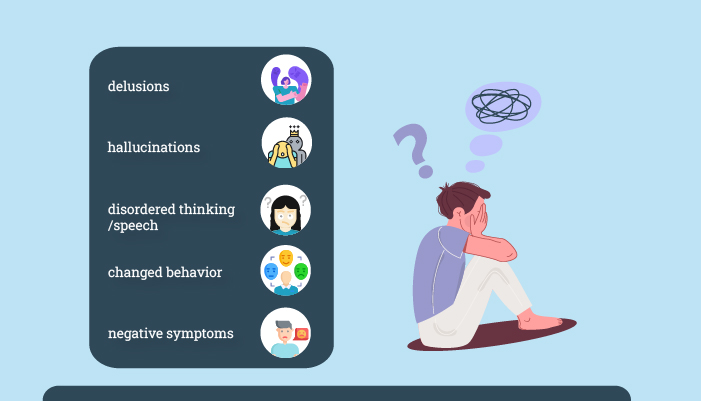
1. Delusions
Delusions are false beliefs that hold strongly and cannot be changed, even though there is evidence that it’s not true. They may remain in a negative perception that everyone around them are enemies or might hurt them.
For example, they think like their food is being poisoned, others are plotting against them, the TV is giving them signals, they have superpowers, and more. They stick to their thoughts, even if someone shows them everything with proof, it is because they don’t have control over their thoughts.
However, there are several types of delusions, such as:
- Persecutorily, in this condition, one may feel like someone is going to harm them anytime.
- Referential, in this state, one may think that external things are giving them signs about something.
- Grandiose, where one may have an overestimation of one’s own skills.
- An erotomaniac, in this state, may realize that unknown people are in love with them.
- Nihilistic, where they believe that something bad is going to happen, it can be a disaster.
2. Hallucination
Hallucinations occur when a part of the brain acts like they see, smells, and hears things that are not seen by others, or not present in reality. For example, one may feel like they have felt the sensation on the skin while no one has touched them, or they may have a taste of food they haven’t tried.
Individuals experiencing schizophrenia spectrum disorder and dementia commonly experience hallucinations. Moreover, people who take substances like alcohol and cocaine excessively can also experience visual and tactile hallucinations.
3. Disordered Thinking/Speech
In this state, one may struggle to speak or organize their thoughts. They withdraw from social activities as they may fear that they might not be able to communicate or might give unrelated details. They might create new words and phrases that no one can understand, speak incoherently & repeat the same statements or words again and again.
4. Changed Behavior
People experiencing this condition act differently from others. They may get very emotional, unpredictable, have poor impulse control, and exhibit catatonic behaviors. One may withdraw from social activities because they may feel like they might do some kind of wrongdoing, which makes them regret it later on.
5. Negative Symptoms
Individuals speak without giving expressions, take care of personal hygiene, and remain isolated, which impacts the relationship with friends and family members. They remain unmotivated and lose all interest or pleasure in life.
What Are The Types of Psychotic Disorders?
The types include schizophrenia, schizoaffective disorder, schizophreniform disorder, delusional disorder, Brief psychotic disorder, and more. However, one of the most common psychotic disorders is Schizophrenia.
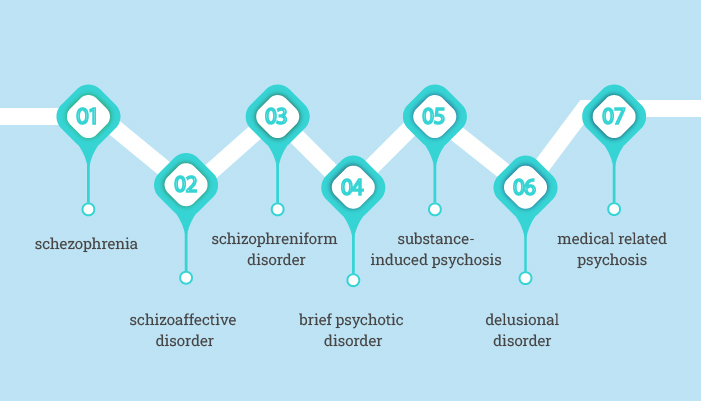
1. Schezophrenia
Schizophrenia is one of the most common psychotic conditions. It is a severe mental health disorder that changes the way of thinking and feeling. People suffering from schizophrenia struggle in life; they are unable to differentiate between delusions and reality.
They also have problems with memory loss and learning ability. It affects cognitive abilities, and individuals have catatonic behavior, where a person moves abnormally, has abnormal behaviors, and may withdraw from others completely.
Learn More about Borderline Schizophrenia
2. Schizoaffective Disorder
This is a hybrid condition where a person experiences the symptoms of schizophrenia alongside mood episodes, such as depressive or manic episodes. Moreover, most of the time, individuals with schizophrenia are incorrectly diagnosed at first with depression or bipolar disorder. It makes the diagnosis difficult and is usually treated as a combination of both conditions.
3. Schizophreniform Disorder
It is a subtype of psychosis in which an individual cannot tell what is real and what is not. It affects thinking, acting, expressing emotions, and relating to others. One may have the same active symptoms as schizophrenia. But it only lasts for six months and then goes away.
4. Brief Psychotic Disorder
It is a short-term episode that is often triggered because of trauma or stress and lasts for less time, usually a month or less. It arises suddenly after experiencing a stressful event and causes hallucinations and false beliefs, such as the death of a loved one, abuse, assault, or disaster. However, brief it can occur at any age, but it usually occurs in adulthood. It completely goes away after getting treatments.
5. Substance-Induced Psychosis
It usually triggers after withdrawal from substances like alcohol, marijuana, cocaine, or medications. It also lasts for a shorter period of time and can be treated.
6. Delusional Disorder
Delusional disorder is a subtype of psychosis that occurs when an individual has one or more delusional thoughts. It lasts for at least one month or more. Mostly, people with this condition function normally or experience paranoia symptoms like being cloned by aliens, thoughts on TV, etc. However, these are only the misinterpretations of their thoughts.
Read More: What’s the difference between Delusional Disorder and Schizophrenia?
7. Medical Related Psychosis
Psychotic disorders can also occur due to other brain conditions. Means any condition that impairs the brain’s abilities can lead to psychosis; these include Parkinson’s disease, Alzheimer’s disease, other dementias, delirium, head injury, brain tumor, or stroke.
What are the Causes & Risk Factors of Psychotic Disorders?
The exact cause of psychotic disorder is still unknown, but according to new research by the National Institute of Health, some of the common factors that may contribute to the development of this include:
1. Genetics & Brain Chemistry
It is a heritable condition that runs in families. For example, if any of the close family members have experienced this condition, there are high chance that you may also develop it. Moreover, if one may have abnormalities in brain neurotransmitters such as dopamine or serotonin, they are at high risk of developing this condition.
2. Environmental Triggers
Many different environmental factors may increase the vulnerability to psychosis. These include:
- Immature birth
- Stressful life events
- Being born in winter
- Head injury in childhood
- Displacement
Note: It’s not always necessary that an individual with psychosis has all environmental factors. They might have one, two, or maybe none of these, but still struggle with psychosis.
3. Substance Abuse
Excessive use of substances can trigger the development of psychosis.
Here are some of the drugs that increase the vulnerability of developing psychosis, these include:
- Cocaine
- MDMA
- LSD (acid)
- Ketamine
- psilocybins (magic mushrooms)
- Alcohol
3. Peripartum Psychosis
Hormonal changes, stress during pregnancy, or difficulty in childbirth may lead to the development of postpartum psychosis. However, one may be more likely to develop postpartum psychosis if they are already suffering from any mental health condition.
4. Brain Chemistry
The dysregulation of neurotransmitters, such as dopamine activity, may lead to hallucinations and delusions. The disturbance of neurotransmitters can also occur due to stressful life experiences, which further leads to psychosis.
5. Medical Conditions
Certain medical conditions, such as brain injuries, infections, anosognosia, and autoimmune diseases, can also make one more vulnerable to developing psychosis. All these conditions affect brain function, causing inflammation and leading to psychotic symptoms like hallucinations or delusions.
6. Medications Side Effects
In some cases, psychosis can also be triggered due to the excessive use of medication or by the side effects of the medications.
Note: Never start medications without the advice of a professional healthcare expert.
How Can Psychotic Disorders Be Diagnosed?
It can only be diagnosed by a professional mental health expert by the criteria of DSM-5 and ICD-10. A mental healthcare professional will conduct a comprehensive medical assessment to diagnose psychosis.
Here is how a healthcare professional can diagnose psychosis:
- They usually conduct a clinical interview and do some questionnaires to observe the behavior and speech.
- They often ask you to get some blood tests to check if the psychosis is caused by substance abuse or other medical conditions.
- Imaging tests, such as CT and MRI scans to check for medical conditions such as a stroke, a brain injury, and tumors.
Psychotic Disorder Treatment
Treatments depend on knowing the exact causes of the condition. However, early intervention is the key for better long-term quality of life. A mental health professional creates a treatment plan according to the severity of the condition, and sometimes combines psychotherapies and medication for better outcomes. Here are some of the common treatments that can be helpful:
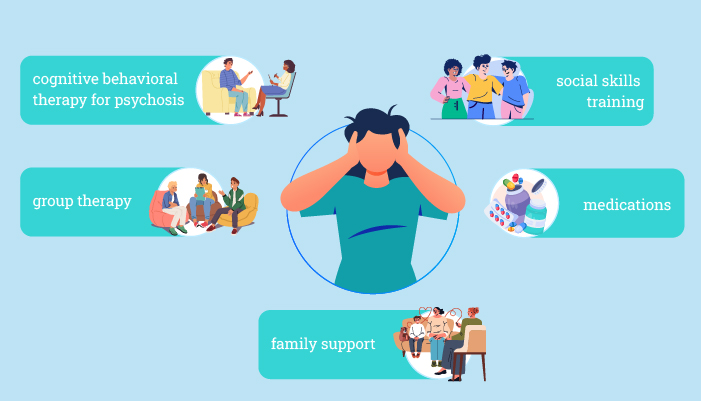
1. Cognitive Behavioral Therapy for Psychosis
CBTp is an evidence-based treatment that has proven effectiveness for treating psychosis. It involves identifying negative thoughts and feelings that are bothering you, and changing them into helpful ones. It helps individuals in a way by identifying triggers and developing “reality testing” skills. CBTp helps in reducing hospitalization and improving the daily-life function of psychotic individuals.
2. Group Therapy
Group therapy plays an important role in reducing the symptoms of psychosis. Individuals in group therapy meet other individuals who are suffering from the same mental health condition. It helps in providing a sense of connection and reduces isolation. People with the same conditions share their experiences, which eventually reduces the stigma and encourages others to stay consistent with the treatments.
3. Family Support
Family support is an evidence-based approach that is designed to help family members of individuals with psychosis. It educates the other members of the family about psychosis.
However, a mental healthcare expert involves all the family members in this therapy.
This therapy helps the individuals to communicate with each other and educates them on how to deal with the symptoms of psychosis.
4. Social Skills Training
Social skills training helps people who struggle with psychosis. It helps them to improve their social skills, interpersonal relations, cultural adaptations, and increases the individual’s ability to focus on goals. However, it can be delivered individually and in groups as well.
5. Medications
Medication works by changing how the brain’s neurotransmitters function. It can be prescribed after looking at the symptoms and severity. Some of the common medications that can be helpful include:
- First-generation antipsychotics
- Second-generation or atypical antipsychotics
Individuals may also need other medications to help manage their negative symptoms (hallucinations, delusions). And sometimes a mental health expert recommends medication to reduce the side effects of medications.
Find Help at Renewed Mental Health Group
If you or someone around you is struggling with a disconnection from reality, you do not have to navigate it alone. Renewed Mental Health Group walks beside you in this journey!
Our highly expert team of psychiatrists and nurse practitioners provides compassionate, evidence-based treatments with a holistic approach. We offer a warm and welcoming environment where you can talk about your issues, which will help you achieve sustainable recovery.
Our top-notch team has decades of experience in treating psychotic disorders and other mental health conditions. We accept major insurances and also offer out-of-network billing options for your ease.
Take the first step today & contact us now!